Building CodeChecker, a Java Static Analyzer with Real-World Constraints
From Open-Source Contribution to Tool Ownership: Designing a Static Code Analyzer by Applying Lessons from Checkstyle

Aspiring MS/MEng in Computer Science (Fall 2026) specializing in systems, software engineering, and scalable distributed technologies. Proven track record as an open-source contributor (100+ merged PRs in Checkstyle) and IEEE-published researcher in blockchain smart-contract systems. Skilled in building high-performance developer platforms, optimizing code quality pipelines, and delivering research-driven, large-scale engineering solutions.
Introduction
Static analysis tools often feel invisible when they work well. As developers, we run them, fix the warnings, and move on. But while contributing to Checkstyle, one of the most widely used Java static analysis tools, I realized that behind every “simple” warning lies a series of deliberate design choices—about correctness, usability, scalability, and developer trust.
In my previous articles, I wrote about my journey contributing to Checkstyle: understanding its architecture, fixing issues, and participating in discussions around code quality enforcement. Those experiences helped me read and reason about a large, mature codebase.
(View these articles at MANISH-K-07/Code Quality Chronicles)
However, there was still a missing piece. I wanted to understand what it truly means to own a static analysis tool end-to-end.
That motivation led me to build CodeChecker, a lightweight Java static analysis tool, explicitly designed to apply the lessons I learned from contributing to Checkstyle—while making different trade-offs where appropriate.
This article reflects on that journey: what I learned from Checkstyle, how those lessons shaped CodeChecker’s design, and what building my own analyzer taught me about static analysis beyond reading existing code.
CodeChecker in Action 🚀
CodeChecker is a professional-grade Java code analysis tool designed for learning, portfolio, and profile-building purposes. It provides code style checks and cyclomatic complexity analysis for Java source files, giving developers insights into code quality, readability, and maintainability.
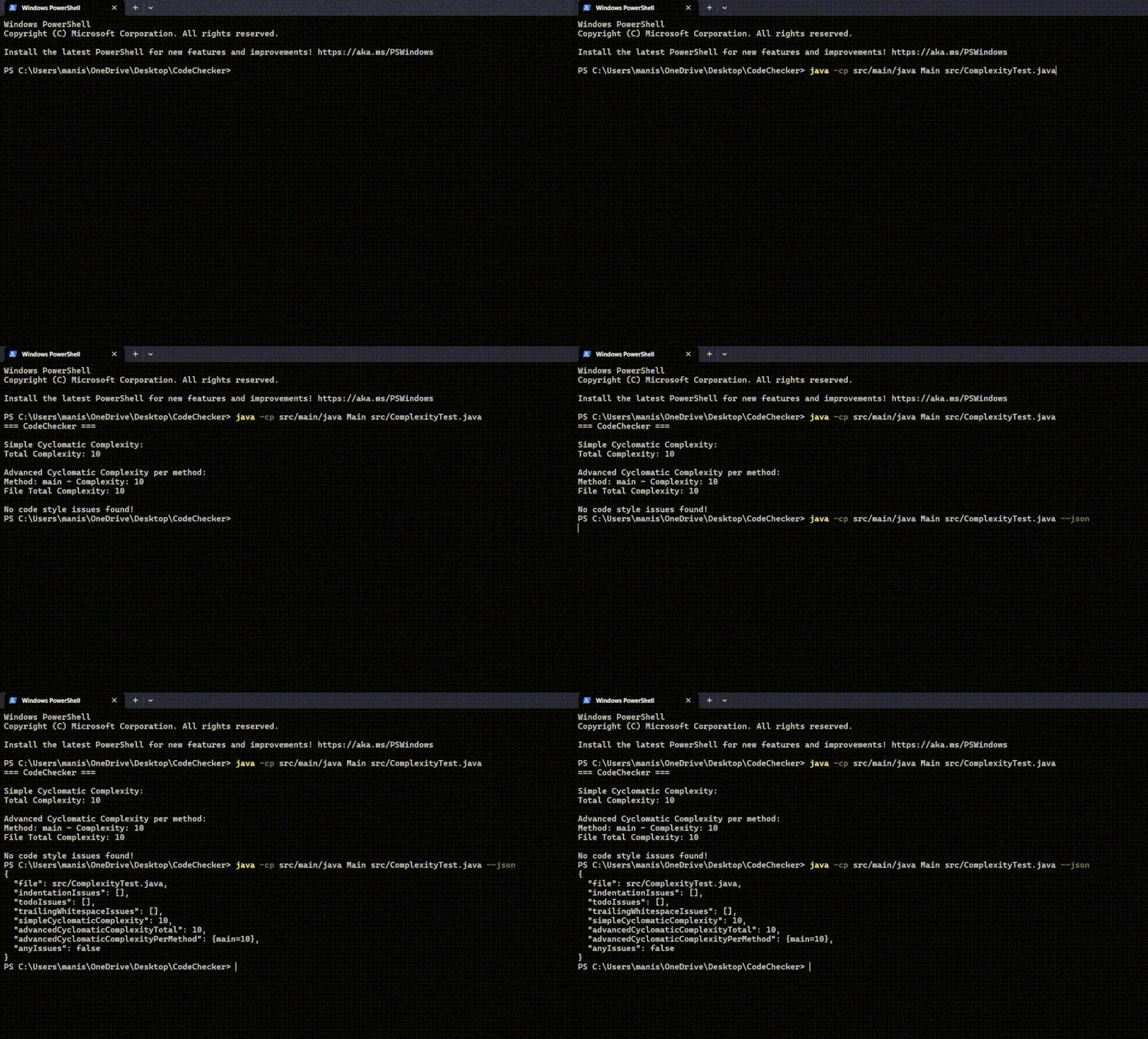
Below is a live demonstration of CodeChecker running in the terminal and printing analysis results in real time. Have a sneak-peek 😉
Repository:
👉 https://github.com/MANISH-K-07/CodeChecker
Why build CodeChecker after contributing to Checkstyle?
Contributing to a mature open-source project like Checkstyle is a valuable experience. You learn how real-world tools evolve, how backward compatibility is maintained, and how small changes can have large downstream effects.
But contributing also comes with constraints:
The architecture already exists
Design decisions were made years ago
Large refactors are rare and risky
I wanted to experience the opposite side: starting with a blank slate and asking fundamental questions:
What minimum functionality makes a static analyzer useful?
How should results be presented to users?
Which problems are easy to detect, and which quickly become complex?
CodeChecker was never meant to compete with Checkstyle. Instead, it was meant to be a learning-focused static analyzer, small enough to understand fully, but realistic enough to surface real design challenges.
Lessons from Checkstyle that directly influenced CodeChecker
1. Separation of concerns is non-negotiable
One of the clearest patterns in Checkstyle is strict separation:
Each check does exactly one thing
Checks do not depend on each other
The engine orchestrates, checks analyze
I followed similar philosophy in CodeChecker.
Each checker is implemented as a separate class:
IndentationCheckerTodoCheckerTrailingWhitespaceCheckerSimpleCyclomaticComplexityCheckerAdvancedCyclomaticComplexityChecker
This structure makes the system:
Easier to extend
Easier to test
Easier to reason about
Even in a small project, violating this principle quickly leads to tangled logic—something I saw repeatedly while reviewing real Checkstyle issues.
2. Deterministic output builds developer trust
One subtle but critical lesson from Checkstyle is that static analysis tools must be predictable. If the same file produces different results across runs, developers lose trust.
In CodeChecker:
Checks run in a fixed order
Results are printed consistently
JSON output follows a stable schema
This may sound trivial, but even minor non-determinism becomes unacceptable when tools are integrated into CI pipelines.
3. Static analysis is more about false positives than detection
While contributing to Checkstyle, I noticed a recurring theme in issues and pull requests:
“This check is technically correct, but it’s annoying.”
That observation heavily influenced CodeChecker’s scope.
Instead of aggressively flagging edge cases, CodeChecker focuses on:
Clear violations (indentation, trailing whitespace)
Explicit markers (
TODO,FIXME)Straightforward cyclomatic complexity calculations
This reinforced an important insight:
A useful static analyzer is not the one that finds the most issues, but the one developers are willing to run daily.
Designing CodeChecker: intentional simplicity
Why regex-based analysis instead of an AST?
Checkstyle relies on a full Java AST, which provides precision and deep semantic understanding. However, building a correct parser is a significant undertaking.
For CodeChecker, I deliberately chose line-based and regex-driven analysis.
This decision was intentional:
It keeps the project focused on analysis logic, not parsing infrastructure
It exposes limitations clearly
It highlights why AST-based tools exist in the first place
This trade-off helped me appreciate the engineering investment behind Checkstyle’s architecture, rather than taking it for granted.
Cyclomatic Complexity: simple vs advanced
CodeChecker includes two complexity analyzers:
Simple Cyclomatic Complexity: counts decision points across the file
Advanced Cyclomatic Complexity: computes complexity per method and totals it
The advanced checker was particularly instructive to implement.
Tracking:
Method boundaries
Brace depth
Decision points (
if,for,while,case, logical operators)
quickly revealed how fragile naive parsing can be. Even small formatting changes affect detection accuracy.
This experience made one thing clear:
Cyclomatic complexity is conceptually simple, but practically subtle.
Output matters: CLI and JSON support
Another lesson from Checkstyle is that output format matters as much as analysis quality.
CodeChecker supports:
Human-readable console output
Structured JSON output (
--jsonflag)
The JSON mode was added to reflect real-world usage:
CI pipelines
Automated reporting
Tooling integration
Designing JSON output forced me to think carefully about:
What information is essential?
How should complexity per method be represented?
What constitutes an “issue” versus informational metrics?
Notably, cyclomatic complexity is not treated as an error in CodeChecker. It is reported for visibility, not enforcement—mirroring how teams often use complexity metrics in practice.
Testing and validation
Even for a small static analyzer, testing proved non-trivial.
Questions I had to answer:
How do you test analysis without overfitting to one file?
How do you validate complexity counts?
What is the “correct” expected output?
Writing ComplexityTest.java and validating both simple and advanced outputs helped me realize that:
Testing static analysis tools is about testing assumptions, not just code paths.
This reinforced the importance of clear definitions and documented behavior—something I had previously observed in Checkstyle’s extensive test suite.
What building CodeChecker taught me (beyond Checkstyle)
While Checkstyle taught me how large tools are maintained, CodeChecker taught me why those design choices exist.
Key takeaways:
Simplicity is a feature, not a limitation
False positives are more damaging than missed detections
Tool UX (output, ordering, clarity) directly affects adoption
Static analysis sits at the intersection of theory and pragmatism
Most importantly, building CodeChecker shifted my mindset from:
“How does this check work?”
to:
“Should this check exist at all, and how will developers perceive it?”
That perspective is difficult to gain without owning the full lifecycle of a tool.
Closing thoughts
Contributing to Checkstyle taught me how high-quality static analysis tools are engineered at scale. Building CodeChecker taught me why those tools are engineered the way they are.
Together, these experiences deepened my understanding of:
Software quality enforcement
Tooling design trade-offs
Developer-centric engineering
CodeChecker is intentionally small, but the lessons behind it are not. It represents my transition from reading and modifying existing systems to designing and justifying systems of my own—a skill I believe is essential for advanced study and research in computer science.
The complete source code for CodeChecker is open-source and available on GitHub—feedback, exploration, and experimentation are welcome.
👉 https://github.com/MANISH-K-07/CodeChecker
👨💻About the Author
I’m Manish Krishna Kandrakota — a final-year Computer Science undergraduate and open-source contributor with hands-on experience in Java static analysis and developer tooling. I contributed to Checkstyle, a widely used industry-grade static analysis tool, and built CodeChecker to apply those lessons in tool design, correctness, and usability. My interests lie in software engineering, program analysis, and building reliable developer infrastructure. I am planning to pursue graduate studies in Computer Science.
🔗 GitHub: MANISH-K-07
🔗 LinkedIn: manish-k-kandrakota


